Everyone Talks About Digitalization. Almost Nobody Talks About What It Runs On

Digitalization is the word of the decade in Africa. It is in national development plans, in ministerial speeches, in bank press releases, in startup pitch decks. Governments announce it. Media repeat it. Companies put it in their taglines.
Underneath the word, there is a much narrower reality.
Nothing digitalizes until money moves reliably. A tax portal that cannot collect payment is a form. An e-commerce platform without settlement is a catalog. A health insurance system that cannot reimburse is a database. Every digitalization project eventually arrives at the same place: someone has to pay someone else, and the system has to be right about it.
So the real question is not whether a country is digitalizing. It is whether it has a payment layer that people can trust without knowing each other.
That layer is what this article is about.
Here is the part that surprises most engineers: a payment system is not an application with a payment API inside it. It is a set of guarantees made to parties who do not trust each other and who still have to agree on who owns what.
That distinction changes everything. It explains why payment systems look over-engineered from the outside. It explains why they refuse things that would be trivial elsewhere. It explains why a team that ships fast in every other domain suddenly slows down here.
Four families of guarantees hold the whole thing together. Understanding them is not optional knowledge for someone building in this space. It is the prerequisite.
Part 1. The landscape: who does what, and who carries which risk
Ask a developer to describe a payment and you usually get two parties. A customer pays. A merchant receives.
That model is wrong in a way that causes real damage. A payment is not a transaction between two parties. It is a chain of responsibilities, and every link in that chain carries a different kind of risk.
The actors, and what they actually do
The merchant sells something and wants to be paid. That is the only simple role in the chain.
The PSP (Payment Service Provider) is the part most people misunderstand. Engineers see it as a technical connector, a nicer API in front of messy operator interfaces. That is the smallest part of what it does. A PSP carries settlement risk, holds funds in transit, absorbs compliance obligations, and stands behind disputes. When a customer contests a transaction three days later, the PSP is in the room. Choosing a PSP is not choosing a library. It is choosing a counterparty.
The acquirer is the institution that accepts the transaction on behalf of the merchant and moves it into the banking system. In card ecosystems this is a distinct regulated entity. In many African contexts the boundary between PSP and acquirer is blurred, and knowing where it actually sits in your specific setup matters more than the textbook definition.
The issuer or the mobile money operator holds the customer's money. This is the party that decides whether the payment happens at all. Everything upstream of this decision is a request, not a fact.
The settlement bank is where value ultimately lands. Not where it is confirmed. Where it lands.
The regulator does not appear in your architecture diagram and constrains it anyway. Thresholds, reporting obligations, licensing, customer identification rules. These shape your data model before you write your first migration.
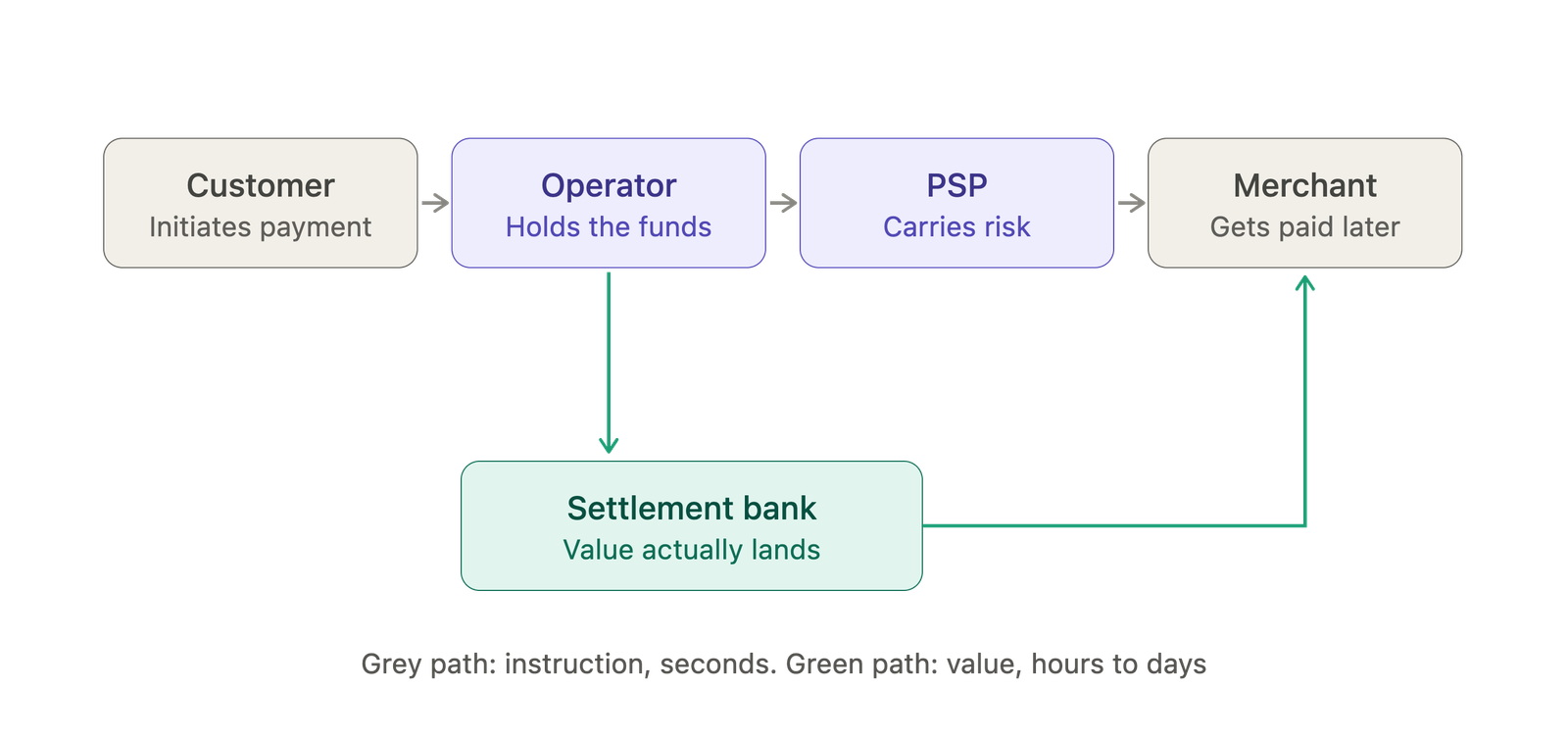
The distinction that almost nobody makes
Three words get used interchangeably by people who should know better. They are not the same thing, and confusing them is how systems end up lying to their users.
| Stage | What it means | Typical delay | What it guarantees |
|---|---|---|---|
| Authorization | The party holding the money confirms it exists and agrees to move it | Seconds | Nothing about receipt. Only intent and capacity |
| Capture | The instruction to actually take the funds is committed | Seconds to hours | The debit is real for the customer |
| Settlement | Value arrives in the merchant's account at the receiving institution | Hours to several days | The merchant can use the money |
A merchant who sees "paid" on a dashboard has usually seen an authorization. The money is not there yet. It may not be there for two days. If your product tells the merchant that money has arrived when it has only been authorized, you have not built a payment system. You have built a display that will eventually be wrong in public.
This gap is where most trust is lost in practice. Not in outages. In the space between what the interface says and what the bank account shows.
What is different about mobile money in Central Africa
In card ecosystems these roles are separated by decades of regulation and infrastructure. In mobile money, the operator is simultaneously the network, the issuer, and the de facto bank. It holds the float, runs the customer relationship, controls the API, and decides the rules.
That concentration changes the risk profile in three concrete ways.
Availability is not something you can architect around. If the operator is down, there is no alternate route to that customer's money. There is no second acquirer to fail over to.
Your integration surface is smaller and more brittle. API semantics vary between operators in ways that are not cosmetic. Status vocabularies differ. Timeout behavior differs. What counts as a final state differs.
And commercially, you have very little leverage. The terms are the terms.
Building here means designing for a dependency you do not control and cannot replace. That is a strategic constraint, not a technical one, and it belongs in the conversation before anyone opens an editor.
Part 2. The truth about accounts
Here is the single idea that separates people who have built payment systems from people who have not.
A balance is not a stored value. It is a computed result.
The instinct of most developers is a balance column on an account row. Payment arrives, add to the column. Withdrawal happens, subtract from it. It works on day one. It is structurally wrong, and it fails in a specific and unrecoverable way.
Why the stored balance destroys you
Not because it is slow. Because it destroys history.
When a balance is a mutable number, an error becomes invisible the moment it happens. If a bug adds 15 000 twice, you now have a number that is wrong and no way to know it, no way to see when it became wrong, and no way to determine what the correct value should have been. The evidence was overwritten by the error itself.
In most software, you can recover from bad data by fixing the code and reprocessing. In payments you cannot, because the outside world moved. Real money left a real person's account. Your database is supposed to be the record of that. If it disagrees with reality and cannot explain why, you do not have a bug. You have a dispute you will lose.
The ledger
The correct model is a journal of entries that is never edited and never deleted.
Every movement of value is recorded as a new line. Lines are immutable. If a mistake is made, you do not fix the line. You add a reversing entry that cancels it, and both remain visible forever. The history of the error becomes part of the record.
A balance, then, is simply the sum of all entries affecting an account. It is derived, not stored. If you need it fast, you cache it, and the cache is a performance detail that can always be rebuilt from the journal. The journal is the truth.
This is not an architectural preference. It is the only model that can answer the question every payment system must eventually answer: not "what is the balance" but "how did it come to be this, and prove it."
Double entry, without the accounting
Double entry sounds like a bookkeeping formality. It is actually an error detection mechanism, and it is the most effective one in the entire system.
The principle: money never appears and never disappears. It only moves. Every amount that leaves one account arrives in another. Every entry has a matching counter-entry, and across the whole system, the sum of all movements must be zero.
The consequence is what matters. If your books do not balance, you have not lost a rounding value. You have money that is unaccounted for, sitting in a place your system cannot name. Double entry does not prevent that from happening. It makes it impossible to hide.
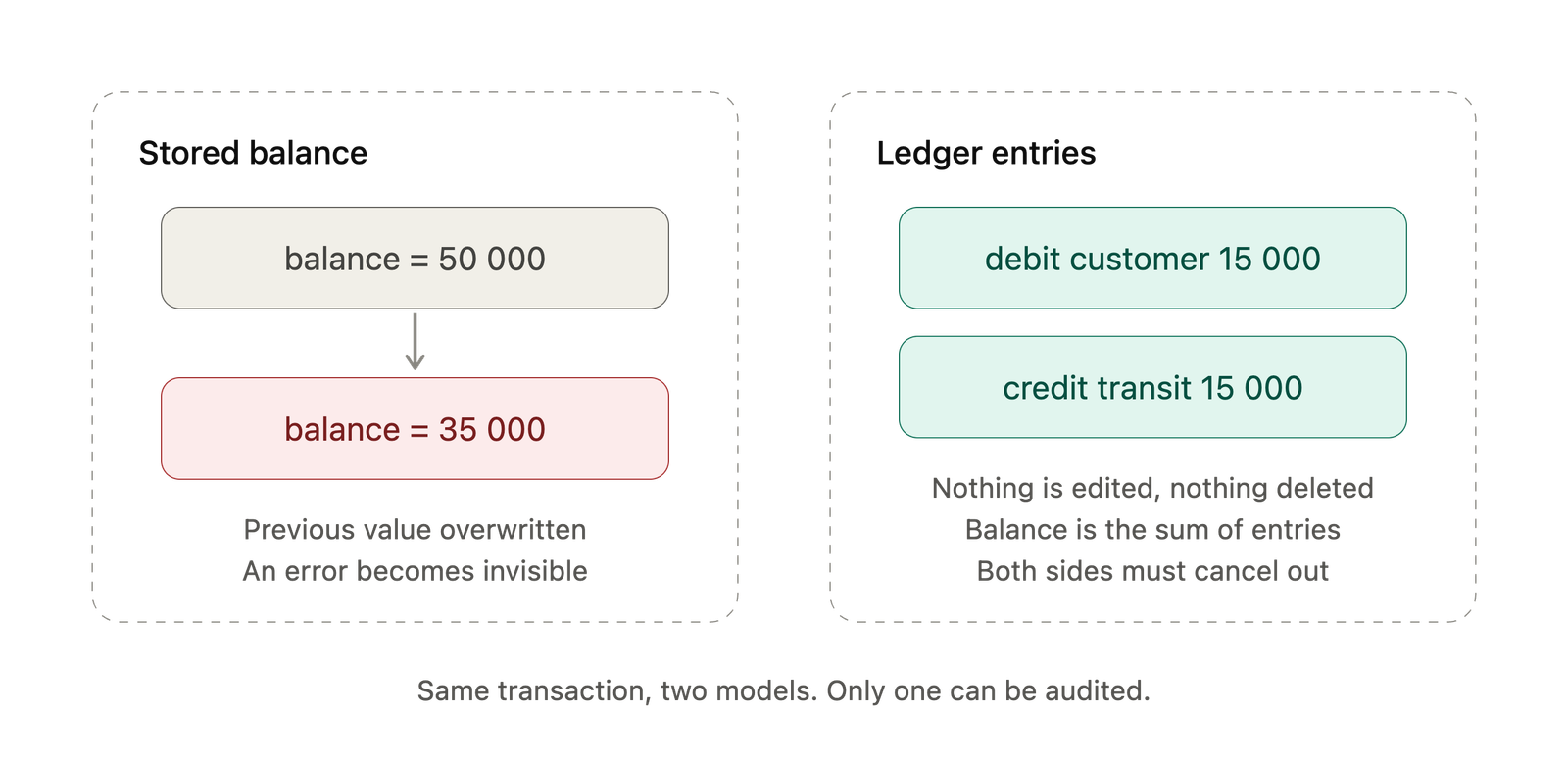
A system without it can be quietly wrong for months. A system with it cannot be wrong for more than a day without someone knowing.
The accounts that belong to nobody
A real ledger contains accounts that do not correspond to any person. They exist because money spends time in places between parties.
A transit account holds funds that have been captured but not yet settled to the merchant. A fee account collects what the platform retains. A suspense account holds amounts the system received but cannot yet attribute to anyone, which happens more often than anyone expects.
These are not workarounds. They are how you make the in-between states of money explicit instead of pretending they do not exist. A system that has no suspense account does not have fewer unattributed payments. It has unattributed payments hidden inside someone else's balance.
Reconciliation
And now the part that humbles everyone.
Your database is not the source of truth. The operator's statement is.
Whatever your ledger says, the authoritative record of what moved is held by the mobile money operator and the settlement bank. Your system's job is to agree with them, and to know immediately when it does not.
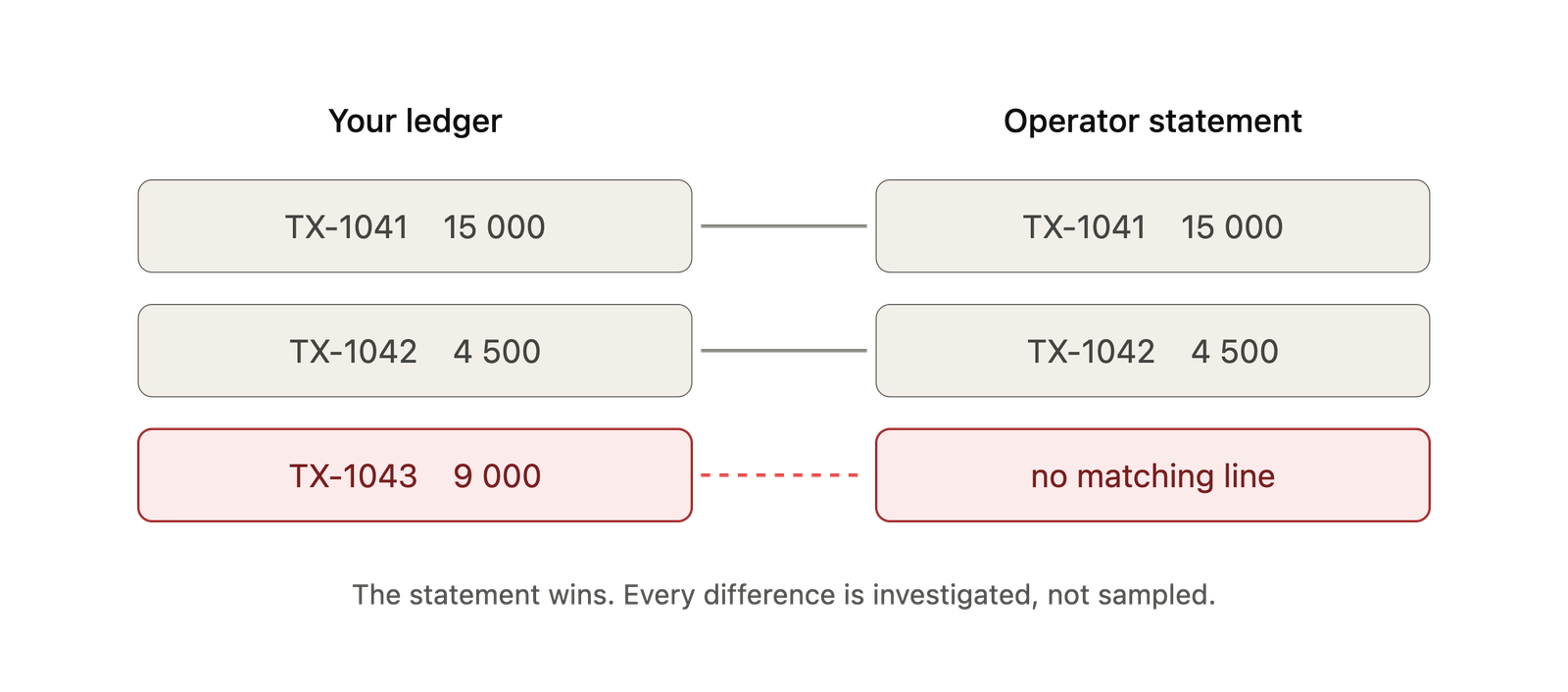
Reconciliation is the daily process of comparing your entries against their statement, line by line, and investigating every difference. Not sampling. Every difference.
A system that does not reconcile daily is not a system that has fewer discrepancies. It is a system that will discover a month of them at once, with no idea which transaction started it.
This is the single practice that most distinguishes a real payment system from a working prototype. Not throughput. Not architecture. Whether someone checks, every single day, that the books match the world.
Part 3. What has to hold when things break
Every system fails. What makes payments different is what failure costs and how it is shaped.
In ordinary software, an error costs a page reload. Here it costs someone real money, and the cost is not symmetric.
Losing a payment is recoverable. Recording it twice is not.
If a transaction is lost, the money is still with the customer or the operator. It can be found, traced, and reprocessed. Reconciliation exists precisely to catch this. It is a problem with a procedure.
If a transaction is recorded twice, you have credited value that never existed. You have paid a merchant money you were not given. You will discover it later, you will have to claw it back from someone who has already spent it, and every party in the chain now has evidence that your system cannot count.
This asymmetry is the design principle behind everything in this section. When in doubt, do less. A missed transaction is a task. A duplicated one is a loss of trust.
Idempotence
Idempotence means the same intention produces the same result no matter how many times it is submitted.
It is not a defensive nicety. It is a requirement, because the network guarantees that duplicates will happen.
A customer taps pay, the response is slow, they tap again. A mobile connection drops mid-request and the client retries. Your own retry logic fires because a timeout looked like a failure when the operation actually succeeded. A user refreshes a confirmation page. An operator sends the same callback twice, which they do, routinely.
None of these are edge cases. All of them are Tuesday.
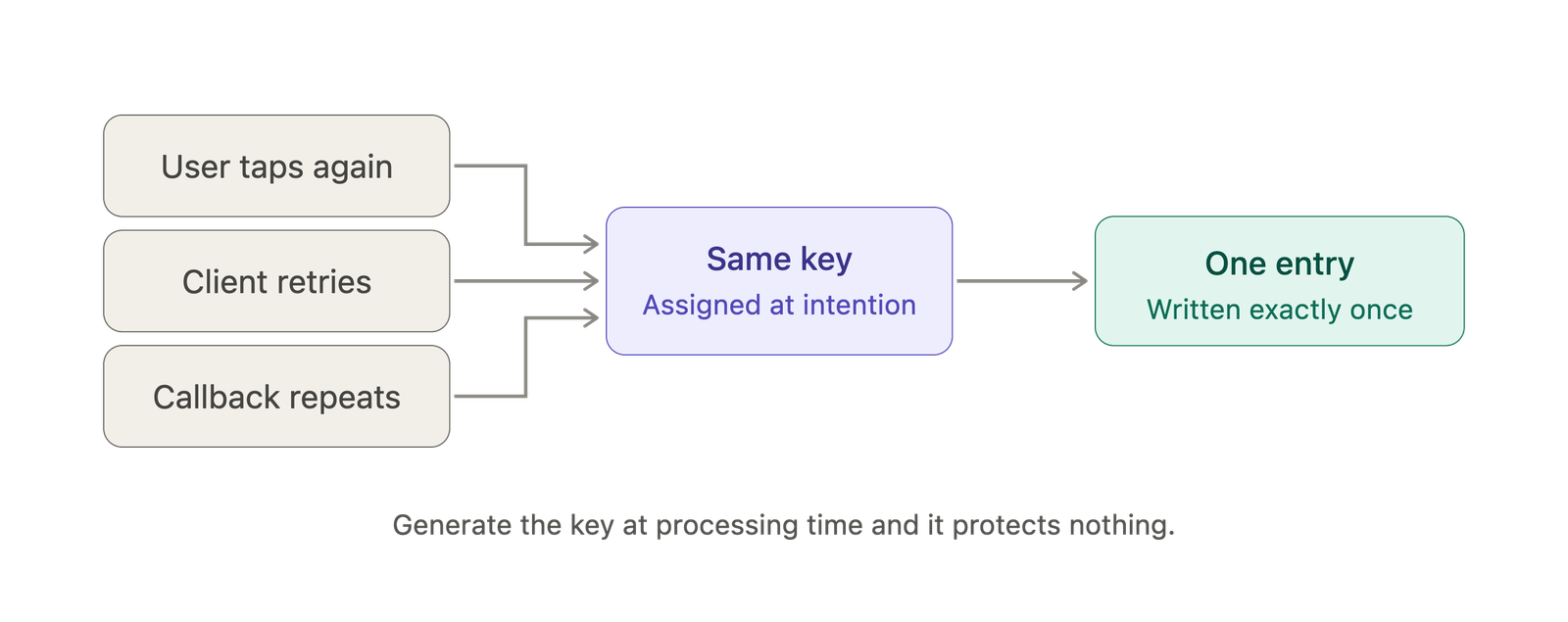
The mechanism is that every payment intention carries a unique identifier assigned once, at the origin, before anything is attempted. Every subsequent operation is tied to that identifier. When the same identifier appears again, the system returns the outcome of the first attempt rather than performing a second one.
The important part is where the identifier is generated. If it is created at the moment of processing, it does not protect against anything, because a retry generates a new one. It has to be created at the moment of intention and carried through the entire chain.
PENDING is a legitimate state
Most engineers model a payment as success or failure. Two outcomes, one boolean, done.
That model is false, and it causes real financial damage.
There is a third state, and it is not an anomaly. A payment can be genuinely in progress: the customer has been prompted, the operator is waiting, the network is slow, the confirmation has not come back. This state can last seconds. It can last forty minutes. In some conditions it lasts hours.
During that window, your system knows one thing only: it does not know.
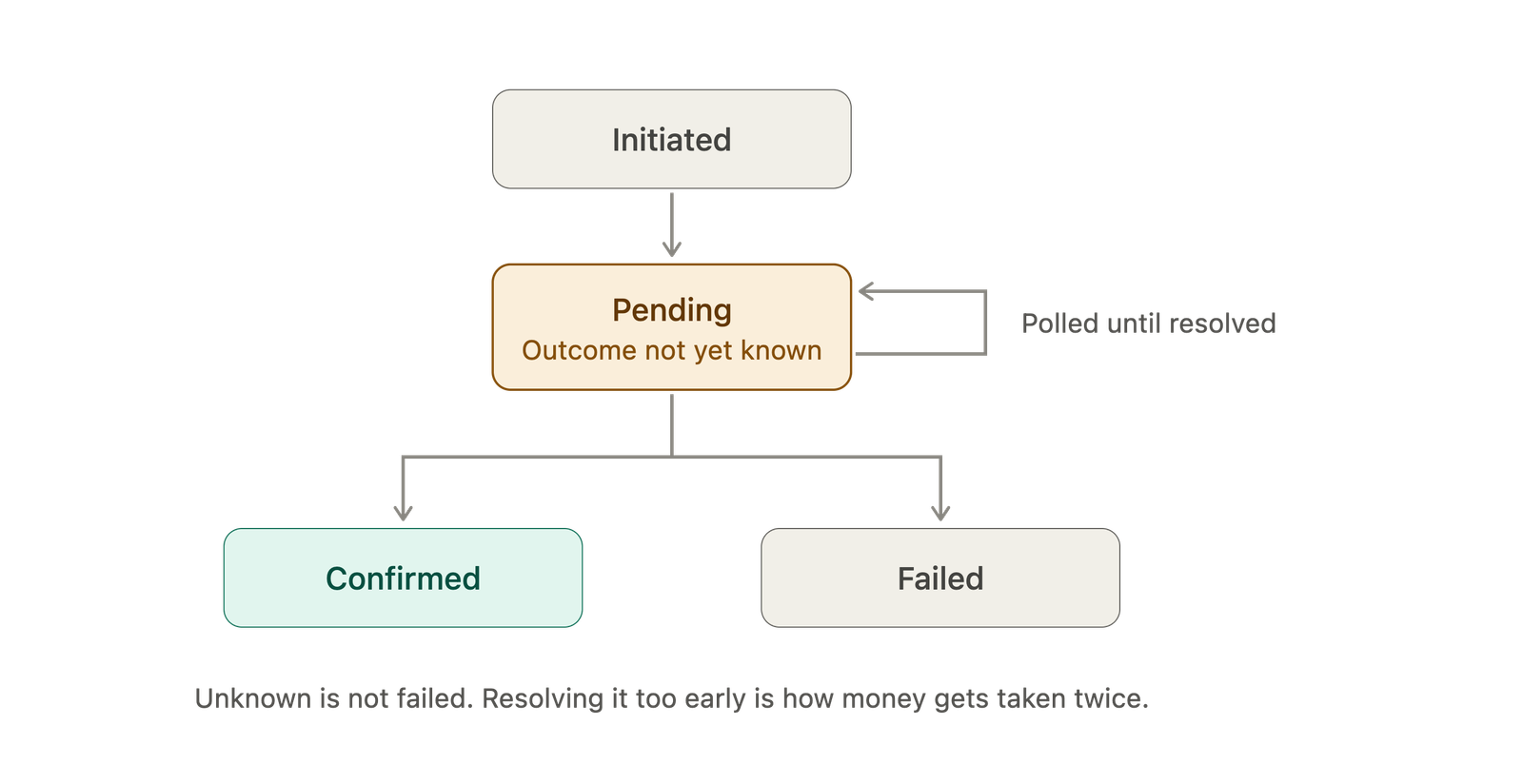
The mistake that hurts is treating unknown as failed. Because if you mark it failed and tell the customer to try again, and the first payment then completes, you have taken money twice from someone who was told nothing happened. That is the asymmetric error, arriving through the front door.
Assume the notification never arrives
Every payment integration offers callbacks. The operator will notify you when the transaction resolves.
Design as though it will not.
Callbacks are lost in ways nobody controls. Your server was restarting. A network partition ate it. The operator's queue dropped it. Their retry policy gave up after three attempts while you were down for four minutes.
A system whose only path to truth is the incoming notification is a system that will be permanently wrong about some fraction of its transactions.
The rule is simple: there must always be a way to ask. Every transaction in a non-final state must be pollable against the operator, and something must be actively doing that polling on a schedule. The callback is an optimization that makes resolution fast. The query is the mechanism that makes resolution certain.
Building it the other way around, with the callback as primary and no fallback, is the most common structural mistake in payment integrations.
Degradation, and the courage to refuse
When a dependency is unavailable, most systems degrade by continuing to accept work and queuing it.
In payments this deserves scrutiny, because accepting a payment you cannot verify is worse than refusing one you could have processed.
Some things can degrade safely. Reading history, viewing past transactions, browsing, generating reports. None of these create financial obligations.
Some things should stop. If you cannot confirm with the operator that a payment succeeded, you should not tell anyone that it did. If you cannot write to the ledger reliably, you should not accept new transactions. A clear refusal costs a customer a few minutes. A false confirmation costs money and credibility.
Knowing which category each operation falls into, in advance, is design work. Discovering it during an incident is not.
The performance question, and why it is not what you think
A short detour, because performance in payments is routinely misunderstood.
Everywhere else, latency is a comfort problem. A slow page is annoying. Users wait or leave.
In payments, latency converts directly into correctness problems.
Past a certain delay, the user concludes it failed. They do not wait. They tap again, or they start a new payment, or they call the merchant who then initiates another request. The slow response did not cost you a few seconds of patience. It generated a duplicate attempt against real money.
This is why performance here is a correctness concern, not an optimization concern. It is also why the honest answer to a slow operation is not always to make it faster. Sometimes it is to make the waiting state visible and unambiguous, so the user knows the difference between "this is still happening" and "this did not work."
The system that tells you clearly that it is still processing is safer than the system that is slightly faster and silent.
Part 4. What has to hold in front of a third party
Everything above concerns the system being right. This section concerns something different and equally important.
The day someone disputes, the system must be able to prove, not to assert.
A customer says they never authorized it. A merchant says they never received it. A regulator asks for records of transactions above a threshold. An internal investigation asks who approved a refund. In each case, "our system says so" is not an answer. It is a claim, and it carries exactly as much weight as the other party's opposing claim.
Non-repudiation
Non-repudiation means a record that no party can credibly deny. Not the customer, not the merchant, and importantly, not you.
That last part is the one teams forget. A log that your own engineers can modify proves nothing about your conduct, because you are also a party to the dispute. Evidence that the accused controls is not evidence.
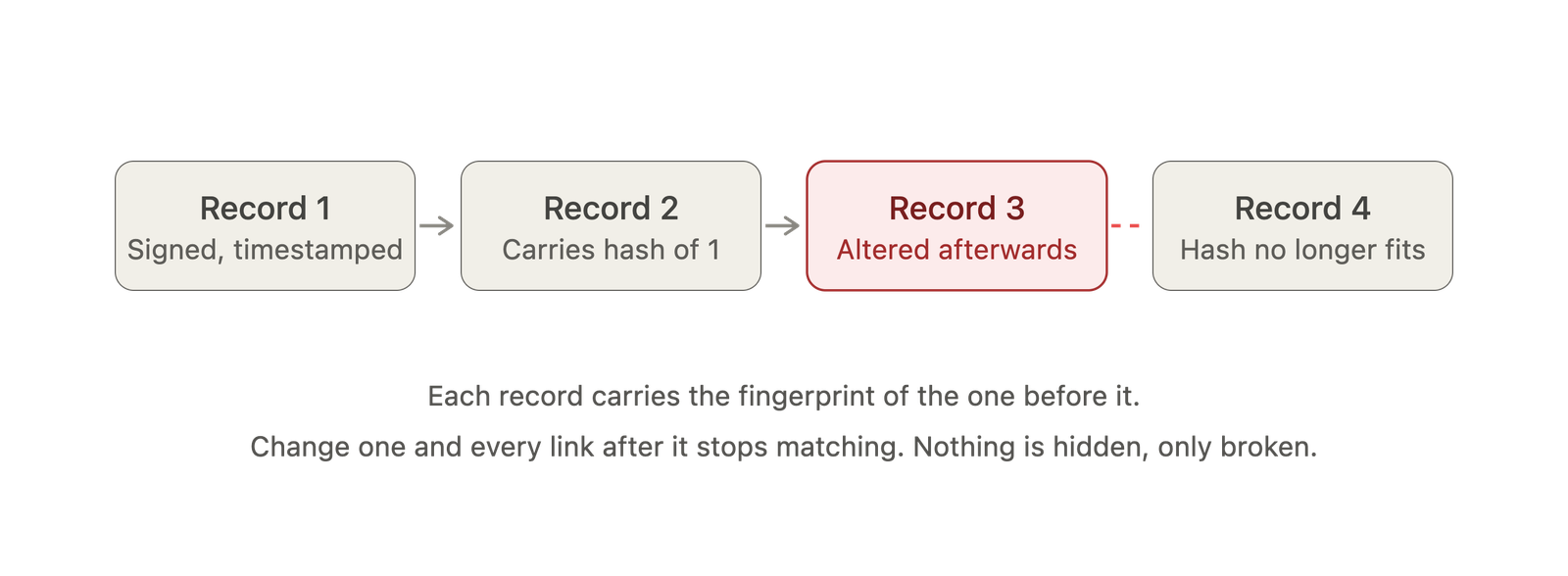
What makes a record hold up is a combination of things: a trace created at the moment of the action rather than reconstructed after, cryptographic signing so tampering is detectable, trustworthy timestamps, and chaining so that removing or altering one record breaks the sequence visibly.
Audit trail is not logging
These two things get conflated constantly, and they serve completely different purposes.
| Application logs | Audit trail | |
|---|---|---|
| Purpose | Help engineers debug | Answer an external party |
| Audience | Your team | Regulator, auditor, court, customer |
| Content | Whatever seemed useful | Every action affecting money or access, without exception |
| Lifecycle | Rotated, sampled, deleted | Retained for a legally defined period, never modified |
| Readable by | Engineers | A non-technical person |
That last row matters more than it looks. An audit trail that only an engineer can interpret does not function as an audit trail. If someone from the regulator or a compliance officer cannot read a record and understand what happened, the record does not do its job.
An audit trail is complete, immutable, retained, and comprehensible. Logs are none of these by design, and that is fine. They are simply not the same artifact, and one cannot substitute for the other.
Security, framed by risk rather than checklist
Security in payments is usually presented as a list: encrypt in transit, encrypt at rest, rotate keys, restrict access. All correct, all insufficient as a way of thinking.
The more useful frame is to ask where value can actually be extracted.
Some of it is external. Credential theft, API abuse, injection, interception. These are real and well understood, and the standard defenses apply.
But a significant share of loss in payment systems is not external at all. It is internal, and it does not look like an attack.
Someone with production database access can adjust a balance. Someone with refund privileges can issue refunds to an account they control. Someone with deployment rights can push code that diverts a fraction of transactions. None of these require breaking in.
This is why segregation of duties, dual approval on sensitive operations, restricted production access, and comprehensive audit trails are not bureaucracy. They are the controls that address the risk that actually materializes most often, which is a trusted person under pressure.
A security posture that treats only outsiders as adversaries is incomplete in a specific and expensive way.
Compliance shapes the data model
KYC requirements, transaction limits, reporting thresholds, retention periods. Engineers tend to treat these as administrative work to be handled later by someone else.
They cannot be handled later, because they determine the data model.
If regulation requires verified identity above a threshold, identity verification state has to exist in your transaction flow from the beginning. If limits apply per customer per period, you need aggregation the moment you have customers. If reports must be produced for certain categories, those categories must be recorded at the time of the transaction, not inferred afterward from data that no longer contains the distinction.
Retrofitting compliance into a live payment system means migrating financial records, which is one of the most dangerous operations you can perform. Building for it from day one costs very little. Adding it in year two costs disproportionately more, and it is done under deadline pressure from a regulator.
Back to digitalization
So: what is a digital payment system?
It is not an interface. It is not a mobile app. It is not an integration with an operator API.
It is a ledger that can prove its own history, a set of guarantees that survive network failure, and a body of evidence that stands up when a third party challenges it. Everything visible sits on top of that. The visible part is the easy part.
This is why the gap between announcing digitalization and achieving it is so wide. Building an interface takes weeks. Building a payment layer that institutions, merchants, and citizens can rely on without knowing each other takes the principles above, applied consistently, and verified daily.
A country digitalizes when that layer exists and holds. Not when the launch event happens.
For an engineer, entering this domain means accepting one specific trade. In most software, shipping speed is the primary virtue and correctness is negotiated against it. Here that order is reversed, permanently. Being right takes precedence over being fast, because the cost of being wrong is not a bug report.
It is someone's money.